
Appliance Removal
We remove old household appliances — fridges, washing machines, cookers and other equipment. We carry them out of your flat and haul them away.
Appliance removal in Riga — fridges, washing machines, cookers and other appliances. We carry them out and haul them away. Price from photos, excluding VAT. We remove old household appliances — fridges, washing machines, cookers and other equipment. We carry them out of your flat and haul them away.
Household appliances are heavy, unwieldy and must not be left by the ordinary bins. An old fridge or a washing machine is beyond one person to carry out, especially from an upper floor. Below is how appliance removal and disposal works and what you need to do before we arrive.
We remove appliances along with furniture or on their own. Our main line of work is furniture removal, but we take appliances along without any trouble.
Which appliances we remove, and what makes each one tricky
Every group of appliances has its own practical problem, and that is exactly what determines how many people are needed and how long the job takes.
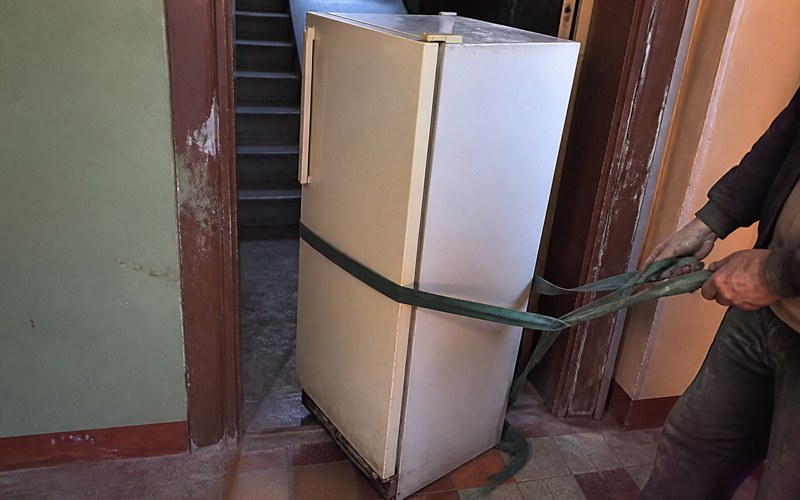
— heavy and tall, with nowhere convenient to grip. The casing is smooth, so you can't take it by an edge the way you would a wardrobe. The doors tend to swing open while it's being carried and hit the banisters or the doorway, so they have to be secured beforehand. On older models the weight sits distinctly towards the top, which noticeably changes the balance on stairs.
— the smallest of the large appliances, but often the heaviest for their size, because there is a concrete counterweight inside. They have to be disconnected from both the water and the electricity. There is almost always water left in the drum and the hose, which spills onto the floor or the stairs during the carry-out if the machine hasn't been emptied first.
— here it matters whether the cooker is electric or gas. An electric one can usually just be unplugged or switched off at the consumer unit. A gas cooker may only be disconnected from the gas supply by an appropriately qualified specialist — we don't do that, and we only remove appliances that have already been disconnected. Built-in ovens have to be lifted out of the kitchen unit first.
— like washing machines, they are connected to the water supply and the drain, so disconnecting them matters just as much. Built-in ones also need the front panel and the fixings to the kitchen unit unscrewed.
— fixed to the wall or a cabinet and connected to a ducting run.
— awkward to carry and easily damaged. Old cathode-ray (CRT) televisions are very heavy for their size and practically always need two people. This is electrical-goods removal and disposal in the same way as for the large appliances.
— microwaves, vacuum cleaners, coffee machines. Taking them on their own isn't good value, but together with large appliances or furniture they go without any extra bother.
Why appliances can't go in the courtyard bin
A fridge, a washing machine or a television is bulky waste — it doesn't fit in a household waste bin and isn't meant to go there. An appliance left by the bins stays standing in the courtyard and becomes the property manager's problem. That is exactly why appliances have to be handed over separately: we carry them out of the flat and take them away for disposal.
What to do before we arrive
None of these steps is compulsory. If you can't or don't want to do them, that's no obstacle — say so in your request and we'll plan the work accordingly. But if they are done, the carry-out goes faster and without surprises.
- Disconnect from the electricity and the waterWherever you can do it safely — pull the plug out, close the stopcock and unscrew the hose. Don't touch the gas connection.
- Empty and defrost the fridgeTake out the food and the shelves, and let the fridge defrost the day before. Otherwise the meltwater runs across the floor and the stairs during the carry-out.
- Drain the washing machineUnscrew the hose over a bucket and empty the filter as well. It takes a few minutes and it saves the stairwell.
- Clear the routeMove rugs and other things out of the hallway and the stairwell — dodging obstacles while carrying a heavy appliance is difficult.
Floor and lift — for appliances that matters more than for furniture
A sofa is big but comparatively light: two people carry it, and the main problem is the size, not the weight. Appliances are the opposite — compact but dense. So stairs change the job far more than they do with furniture: every landing needs a regrip, narrow turns in pre-war stairwells make it impossible to carry an appliance straight, and a fridge or a washing machine mustn't be laid on its side, because it has to be held steady.
We do carry appliances down from upper floors with no lift. But for the price we quote not to change on the day, the form needs the floor and whether the building has a lift. If there is a lift but the fridge doesn't fit in it, that's worth mentioning too. From that information we work out how many people to send.
Price, and why together with furniture is better value
Appliance removal is priced the same way as furniture — from €30 per unit, minimum order €30. Prices exclude VAT.
The practical side: if the only thing to go is one old microwave, you still pay the minimum order. So if you're planning to remove furniture as well or to clear a flat, it's worth adding the appliances to that same trip — everything goes at once and you don't pay the minimum order twice.
What we don't remove
So we don't waste your time: we don't take construction waste, hazardous waste or tyres. We also don't move appliances to a new address — we carry them out and take them away for disposal, we don't deliver them elsewhere. We don't disconnect gas appliances from the gas supply.
We also take completely broken, rusted or already dismantled appliances. It changes nothing in the price or the work — it goes for disposal either way.
How to book
Send photos showing the appliances, tell us the floor and whether there is a lift, and whether the appliances are disconnected. We'll send you a price that doesn't change afterwards.
Related: fridge removal, other bulky items.
Get a price from your photos
Fill in the form and attach photos of what needs to go. We'll call you with a price, and you pick a time that suits you.
Frequently asked questions
Yes. Fridges and freezers are one of the appliances we remove most often. If you can, empty them beforehand and let them defrost.
From €30 per unit, excluding VAT. The minimum order is €30. It's better value to remove appliances together with furniture in one trip.
If you can, disconnect them from the electricity and the water before we arrive. If that isn't possible, it's no obstacle — say so in your request.
Yes, including with no lift. Because appliances are heavy, the floor and whether there is a lift have to be given in the form.
We remove a gas cooker that has already been disconnected from the gas supply. Disconnecting it from the gas may only be done by an appropriately qualified specialist, and we don't do that.
Yes. Broken, rusted or already dismantled appliances are removed just the same — they go for disposal either way.
Yes, and it's usually better value. Everything goes at once and you don't pay the minimum order twice.
No. Fridges, washing machines and televisions are bulky waste, which doesn't fit in a household waste bin and isn't meant to go there.
Disconnect it from the water and the electricity and drain the water from the hose and the filter. Otherwise the water left inside spills onto the floor or the stairs during the carry-out.